
Policy Framework
The engine behind compliance and lending behavior

Canopy's policy framework provides a hierarchical system for defining, enforcing, and managing the rules that govern your lending program. This framework ensures regulatory compliance, operational consistency, and product flexibility through three interconnected components: Locale Rule Sets, Templates, and Policies.
Understanding how these components work together, and their hierarchical relationship, is essential for configuring lending products that meet both regulatory requirements and your business needs.
Framework Hierarchy
The policy framework operates as a top-down hierarchy where higher-level rules constrain and inform lower-level configurations:
1. Locale Rule Sets (Jurisdiction Level)
- Highest level of the hierarchy
- Enforce country and jurisdiction-specific regulatory requirements
- Define hard constraints that cannot be violated by any lower-level configuration
- Example: Maximum interest rates, fee caps, permitted product types
2. Templates (Product Blueprint Level)
- Collections of policies that define product behavior
- Must comply with applicable locale rule set constraints
- Applied to accounts and credit constructs at origination
- Provide reusable product configurations across your lending program
3. Policies (Behavioral Rule Level)
- Individual rules that determine specific behaviors
- Scoped to distinct entity levels: Accounts, Credit Constructs (lines, loans, advances), Transaction Groups, and Transactions
- Work together within templates to create complete product definitions
- Must align with both template design and locale rule constraints
Entity Scoping
Policies are scoped to specific entity levels, creating clear boundaries for where each rule applies:
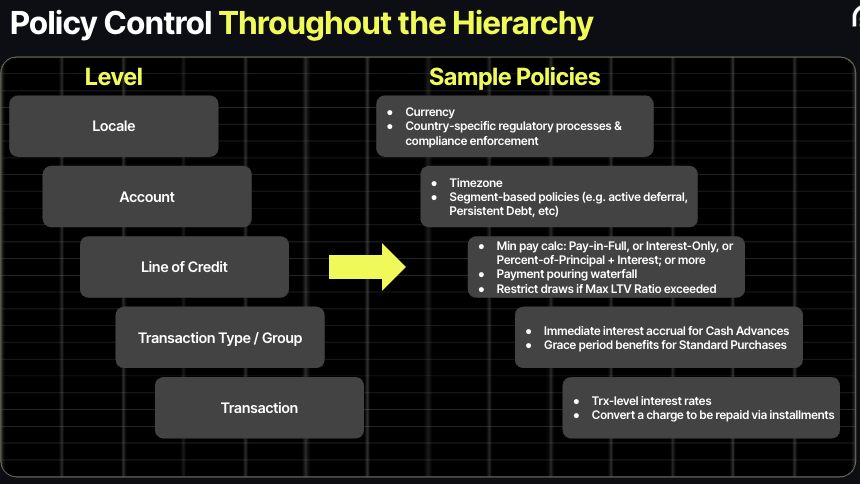
Locale Level: These are more rules to govern the rest of the policies in the hierarchy
Account Level: Policies that govern the overall account structure, how accounts are segmented, timezones in which credit products are processed in, etc.
Credit Construct Level: Policies specific to individual lines of credit, loans, advances, or cards—the specific borrowing instruments within an account.
Transaction Group Level: Policies that govern APR buckets and groups of related transaction types, defining how different categories of charges are treated.
Transaction Level: Policies controlling individual transaction behaviors, such as how specific fees, payments, or charges are processed.
This scoping ensures that policies operate at the appropriate level of granularity without conflicting with policies at other levels. There are no overrides—each policy lives at exactly one scope.
Practical Workflow
When configuring a lending product in Canopy, the hierarchy guides your workflow:
- Identify applicable locale rule sets for your target jurisdiction
- Select or create templates that comply with those locale rules and match your product design
- Review constituent policies within templates to ensure they create the desired product behavior
- Apply templates at origination to accounts or credit constructs, ensuring consistent policy enforcement
Throughout this process, Canopy's client success and delivery teams work hand-in-hand with you to ensure proper use of the policy engine, so that it validates each configuration against higher-level constraints, preventing non-compliant setups before they reach production.
Why This Matters
Compliance Assurance: The hierarchical structure ensures that jurisdictional requirements are always enforced, reducing regulatory risk.
Operational Consistency: Templates and policies create standardized product behaviors across your lending program, reducing configuration errors.
Flexibility with Guardrails: While the framework enforces necessary constraints, it provides flexibility to create diverse product offerings within compliant boundaries.
Clear Accountability: The explicit scoping of policies to entity levels eliminates confusion about where rules apply and makes troubleshooting straightforward.
Learn More
- Locale Rule Sets: Understand jurisdiction-specific compliance enforcement
- Templates: Learn how to create and manage product blueprints
- Policies: Explore individual policy types and their behaviors
Updated 11 months ago